
United Kingdom
The United Kingdom of Great Britain and Northern Ireland (the United Kingdom or the UK) is a prosperous country with a high standard of living, strong economy, high quality healthcare, world-class education, and is one of the world’s top relocation destinations.

population of the UK?
Approximately 69.3 million people live in the UK, including about 11 million foreign-born residents, accounting for around 16% of the United Kingdom’s population (Oxford University Migration Observatory).
There are around 58.62 million people living in England, 5.54 million in Scotland, 3.18 million in Wales, and 1.92 million in Northern Ireland, according to the UK Office of National Statistics (ONS, 2024).
largest cities in the UK?
The largest cities in the UK include London (England), Birmingham (England), Manchester (England), Leeds (England), Glasgow (Scotland), Southampton (England), Liverpool (England), Newcastle upon Tyne (England), Sheffield (England), Bristol (England), Belfast (Northern Ireland), Brighton (England), Leicester (England), Edinburgh (Scotland), and Cardiff (Wales), among others.
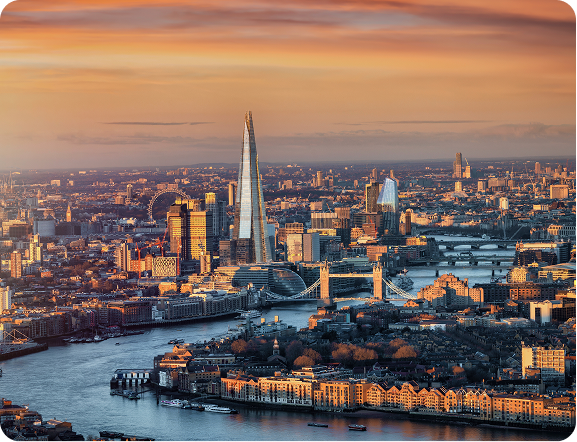
London, the national capital of the United Kingdom, is the largest city and even more diverse than the country as a whole, with around 40% of the approximately 9 million residents of the Greater London area foreign-born and about 300 languages spoken there.
high standard of living in the UK?
There is generally a high standard of living in the United Kingdom.
For example, the UK Office of National Statistics (ONS) reported (December 10, 2025) that the average life expectancy at birth in the UK is 82.6 years for females and 79.4 years for males.
Since the United Kingdom has universal healthcare through the National Health Service (NHS), it is not surprising that there is a high average life expectance in the UK.
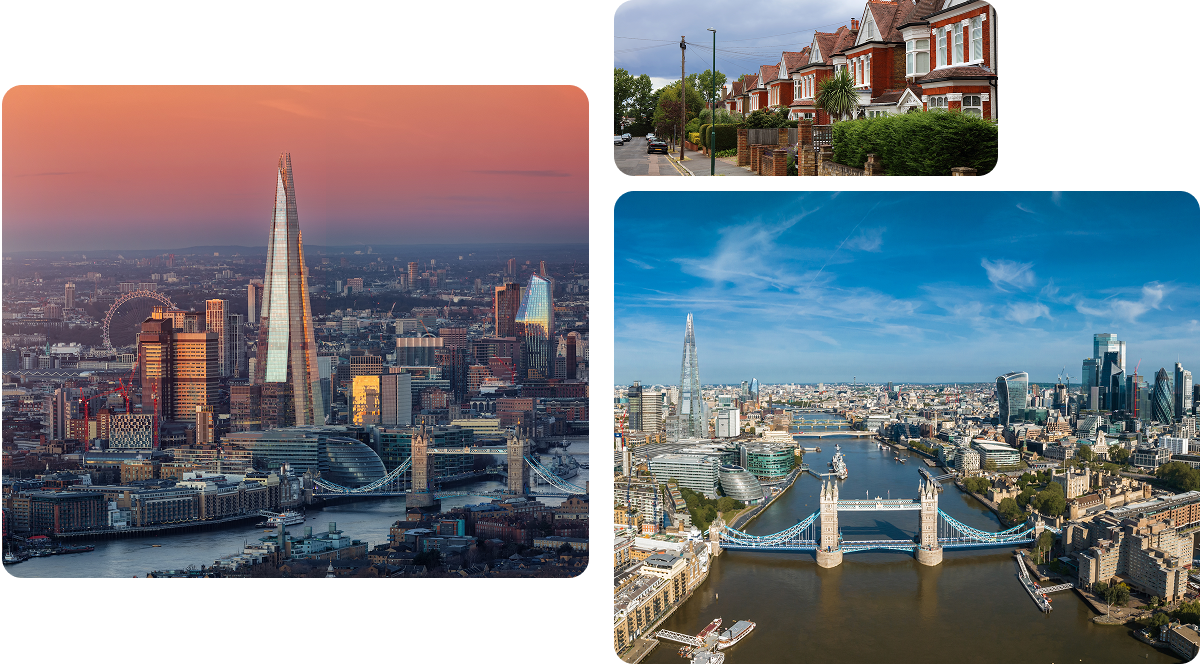
According to a worldwide survey of 17,000 people conducted by US News & World Report, BAV, and the Wharton School at the University of Pennsylvania, the United Kingdom is considered to be the #8 best country overall and is ranked #11 in the world for quality of life (US News & World Report, September 10, 2024).
The 2024 HSBC Expat Explorer report declared, “Foreigners continue to be drawn to the UK by its attractive career prospects and the opportunity for personal development… Expats are attracted to the UK’s political stability, good working conditions and high standard of living.”
Additionally, the 2023 Legatum Prosperity Index rated the United Kingdom as the #12 most prosperous country in the world out of 167 countries examined.
These are just some of the indicators of the general high standard of living in the UK.
UK have a strong economy?
The UK has the world’s 6th largest economy, boasting a Gross Domestic Product (GDP) of $3.68 trillion USD (World Bank, 2024), and is a member of the Group of 7 (G7) major industrial countries.
The top business sectors of the British economy include: financial services; professional and business services; digital and technology; creative industries; healthcare; life sciences; retail and wholesale; construction; manufacturing; aerospace; and renewable energy.
Top exports from the UK to other countries include: crude oil, gasoline, gold, platinum, diamonds, vehicles, auto parts, pharmaceuticals, aircraft, aircraft parts, yachts, machinery, gas turbines, engines, computers, phones, beauty products, and medical instruments.
The UK’s leading export partners are the European Union, the United States, China, and Switzerland.
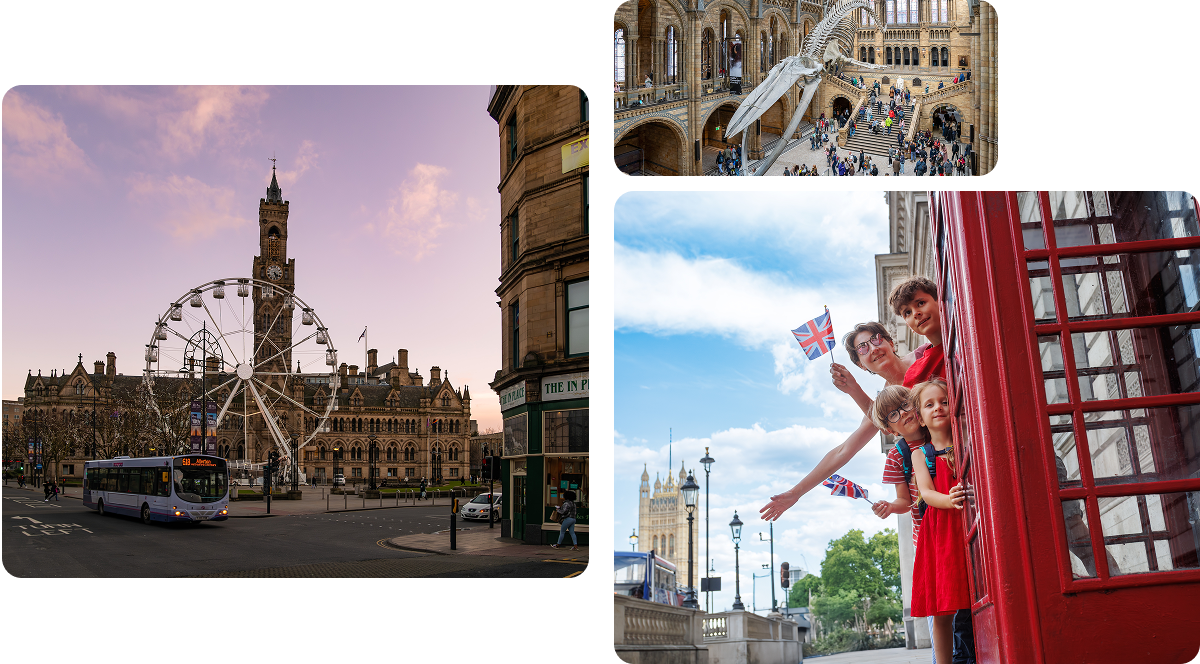

Leading import partners of the United Kingdom include the European Union, United States, China, and Turkey.
As of November 2025, there were around 729,000 UK job vacancies, according to the UK Office of National Statistics (December 16, 2025).
The UK Office of National Statistics (ONS) also reported that the national unemployment rate in the UK was a low 5.1% in the August-October 2025 time period).
Consequently, there is a high demand in the UK for skilled foreign workers in a range of occupations, including in the healthcare, social care, engineering, information technology, construction, sciences, research, and education sectors of the British economy.
According to the UK Office of National Statistics (ONS), the gross median salary in the UK for full-time workers during April 2025 was £37,439 per year, however, the gross median salary in London for full-time workers was £49,692 annually.
The UK Office of National Statistics (ONS) also reported (October 2025) differences in median gross annual salaries for full-time workers in different age brackets: 18-21 (£25,948); 22-29 (£33,696); 30-39 (£41,860); 40-49 (£45,240); 50-59 (£43,212); and 60+ (£37,804).
· Architect = £45,894
· Bricklayer/Mason = £30,939
· Certified/Chartered Accountant = £46,847
· Civil Engineer = £45,524
· Electrical Engineer = £53,488
· Electrician = £35,494
· Finance and Investment Analyst = £40,629
· Financial Institution Manager = £70,000
· Human Resources Manager = £49,409
· IT and Communications Director = £80,000
· IT Network Professional = £42,841 IT Project Manager = £51,933
· · Marketing Associate = £30,601
· Marketing Director = £83,015
· Office Manager = £35,000
· Nurse = £41,523
· Pharmacist = £46,139
· Physiotherapists = £40,888
· Primary School Teacher = £40,059
· Public Relations Professional = £79,886
· Secondary School Teacher = £42,818
· Social Worker = £40,713
· University Lecturer/Professor = £47,726
· Veterinarian = £48,062
UK have a good education system?
The United Kingdom has a world-class education system that provides its residents with a high-quality education and also attracts around 700,000 international students from around the globe.
The education system in the UK is categorized into the following major groups: primary education, secondary education, further education, and higher education.
In England and Wales, it is mandatory for children between five and 16 years of age to get a full-time education.
There is an option for parents in the UK to choose whether their children will receive an education in the public state schools or in private schools.




Between five and 11 years of age, children attend primary school in the UK.
Children attend secondary school in the UK when they are 11-16 years of age.
While attending secondary school in the UK, children who are 14-15 years of age will prepare for the General Certificate of Secondary Education (GCSE) exams, which they will take when they are 16-years-old, by focusing on 8-10 major subjects.
After receiving their GSCE, youth in the UK who are 16-18 years of age will normally complete Advanced Level (A-Level) courses in preparation for applying to university; or they might start an apprenticeship or training program; or they may choose to attend a further education (FE) college.
It generally takes university students in the UK three years to graduate with their Bachelor of Science (BSc), Bachelor of Arts (BA), or Bachelor of Engineering (BEng) degree.
Receiving a higher education in the United Kingdom can open the door to a lifetime of opportunities, particularly since the UK has many of the 100 best universities in the world, including: Imperial College London, University of Oxford, University of Cambridge, University College London (UCL), King’s College London, University of Edinburgh, University of Manchester, University of Bristol, London School of Economics and Political Science (LSE), University of Warwick, University of Birmingham, University of Glasgow, University of Leeds, University of Southampton, University of Sheffield, Durham University, and the University of Nottingham (QS World University Rankings 2026).


quality healthcare in the UK?
British citizens and other legal residents of the United Kingdom have access to high-quality public healthcare through the National Health Service (NHS), which is one of the most respected healthcare systems in the world.
There is free access to the NHS for citizens of the United Kingdom and “ordinary residents” with Indefinite Leave to Remain (ILR) status (i.e., permanent residents of the UK).
Note: The United Kingdom’s National Health Service (NHS) receives funding from National Insurance Contributions.
Individuals with temporary legal status in the UK (for example, people with a valid UK work visa) can also access the NHS, however, they have to pay the Immigration Health Surcharge.




Most NHS healthcare services are free, however, there are reasonable dental care fees, and England charges a small fee (about £9.90) for prescription medicine.
Note: Dental care is generally free for children under 18 years of age living in the UK, and prescription medicine is generally free to residents of Wales, Scotland, and Northern Ireland.
The United Kingdom has many independent pharmacies, plus a lot of retail stores and supermarkets also have pharmacies, which offers easy access to prescription medicines.
Except in emergencies, an individual’s local general practitioner will usually be the first point of contact for healthcare in the UK.
In order to visit a healthcare specialist or obtain treatment in a hospital, an individual will normally need to get a referral from their local general practitioner.
Generally, a referral from an individual’s local general practitioner will be needed in order to receive free mental healthcare services offered by the NHS, however, self-referral might be possible in certain situations.
Although the United Kingdom has a highly-rated public healthcare system, approximately 10% of the people living in the UK decide to pay premiums to also get access to private healthcare, which may allow them to have a private hospital room, visit a healthcare specialist in less time, or enjoy other advantages (depending on their private healthcare policy).
Note: Private hospitals in the UK normally charge a fee for their services, while NHS hospitals generally provide free healthcare services to those who qualify.

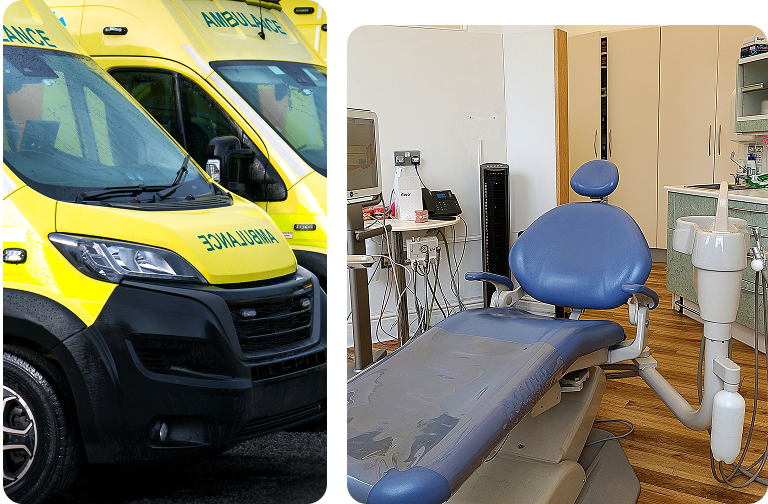
There are different types of hospitals in the UK, including: public and private hospitals (as discussed earlier); general hospitals (for outpatient services, surgery, emergency treatment, care for the elderly, and maternity services); and specialist hospitals (such as eye hospitals, orthopedic hospitals, etc.).
Additionally, there are approximately 80 NHS walk-in health clinics across the United Kingdom (mostly in England), where residents can get treated seven days a week for minor injuries or illnesses (for example, fractures, burns, small cuts, bruises, infections, etc.).
Hospitals in the UK generally have an Accident and Emergency (A & E) Department that is open 24 hours daily.
In the United Kingdom, people can dial “999” on their phones to report a medical emergency.
people legally relocate to the UK each year?
Approximately 852,000 people were issued a UK non-visitor visa for temporary legal residence in the United Kingdom (e.g., student, work, family, humanitarian) in the 12-month period ending in June 2025, including around 183,000 main applicants through various work visa categories (e.g., Skilled Worker Visa, Health and Care Worker Visa, Global Talent Visa, etc.), according to data released by the British Government (UK Home Office, Summary of latest statistics, October 20, 2025).
UK non-visitor visas granted for relocation in the year ending June 2025 included (UK Home Office, Summary of latest statistics, October 20, 2025):
Study Visas
414,000
Work Visas
183,000
Family Visas
76,000
Humanitarian Visas
62,000
As one of the world’s top relocation destinations, the UK is a multicultural country in which around 16% of the United Kingdom’s population is foreign-born.
The highest percentage of foreign-born residents in the UK live in England (around 16%), followed by Scotland (around 9%), Wales (around 6.9%), and Northern Ireland (around 3.4%), according to 2021 Census data.
In Greater London, about 40% of its nine million residents were born overseas (The Migration Observatory at the University of Oxford) and approximately 300 languages are spoken there (Greater London Authority).
Around 63% of the foreign-born residents of the United Kingdom are from non-EU countries, while about 37% of foreign-born UK residents are from countries in the European Union, according to The Migration Observatory at the University of Oxford.
The UK Office of National Statistics (ONS) reported that in the 12-month period that ended in June 2025, 75% of the individuals relocating to the UK were nationals of countries located outside of the European Union (EU), whereas 9% of the people relocating to the UK were nationals of the EU (UK House of Commons Library, Migration Statistics, December 1, 2025).
Major reasons that nationals from non-EU countries immigrate to the UK (2024) are to study (47 percent); to work (32 percent); family (10 percent); and humanitarian (5 percent), according to The Migration Observatory at the University of Oxford, referencing an Office of National Statistics report.
government does the UK have?
The United Kingdom has a constitutional monarchy with a parliamentary government (known officially as His Majesty’s Government).
London is the capital city of the United Kingdom and the location of the British Parliament, Prime Minister, Cabinet of Ministers, Supreme Court, and Buckingham Palace (one of the royal residences of King Charles III).
The British Parliament is made up of a lower house (the House of Commons), an upper house (the House of Lords), and includes the Cabinet of Ministers which is led by the Prime Minister, who serves as Head of Government. Elections are held periodically to allow citizens of the United Kingdom to vote for Members of Parliament (MPs) who will represent them in the House of Commons. The political party with the most MPs in the 650-seat House of Commons (currently, the Labor Party) generally chooses the next UK Prime Minister who will then form the British Government.
Sir Keir Starmer has been the Prime Minister (PM) of the United Kingdom since July 5, 2024. Under the British parliamentary form of government, the Prime Minister serves as the head of the executive branch and the legislative branch of the UK Government, and is tasked along with the Cabinet of Ministers to run the national government. The Prime Minister’s office and official residence is located at 10 Downing Street in London.

The Monarch and Head of State of the United Kingdom is King Charles III, who began his reign on September 8, 2022, following the death of his mother, Queen Elizabeth II, who ruled as Monarch for more than 70 years.
Nowadays, the Monarch serves more of a symbolic and ceremonial role in the United Kingdom (for example, his image appears on British currency; he is the King of Canada, Australia, and New Zealand; he is the Head of the Commonwealth; etc.).
Nevertheless, the Monarch retains the authority to appoint or dismiss the Prime Minister; he is the Head of the British military; his signature is needed for bills passed by Parliament to become law; he can dissolve Parliament; and he has the Royal Prerogatives to declare war, make peace, summon Parliament, negotiate international agreements, appoint or dismiss Cabinet ministers, regulate the civil service, issue British passports, etc.
Some of the other powers possessed by the Monarch include appointing Lords to the Parliament’s House of Lords; pardoning criminals; being immune from prosecution; appointing knights; not having to pay taxes; he is “Defender of the Faith” (i.e., Head of the Church of England); his cars do not require license plates; he does not need a driver’s license; and no passport is required for the Monarch to travel overseas – among other powers.
The official residences of His Royal Majesty include: Buckingham Palace in London; Windsor Castle and Sandringham Estate, also located in England; Balmoral Castle in Scotland; and Hillsborough Castle in Northern Ireland.
points of interest in the UK?
The United Kingdom is a beautiful country with a fascinating history and rich culture, offering many points of interest worth checking out, including vibrant cities (like London), picturesque towns, majestic castles, scenic coastlines, world-class museums, peaceful parks, vast wilderness areas – and more!
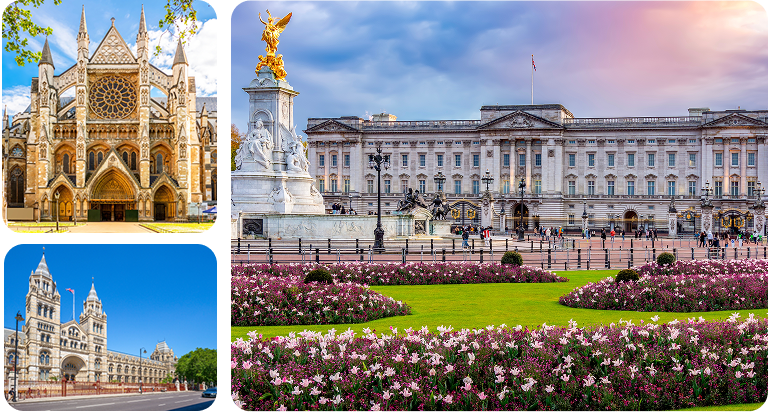
Points of interest in Greater London include: Buckingham Palace; Westminster Abbey; The British Museum; Trafalgar Square; Parliament and the Elizabeth Clock Tower (“Big Ben”); Tower Bridge; the Tower of London; Science Museum; Hyde Park; Piccadilly Circus; the London Eye (“Millennium Wheel”); Natural History Museum; St. Paul’s Cathedral; London Zoo; St. James Park; National Portrait Gallery; and the Royal Botanical Gardens, Kew. Greater London also offers diverse shopping opportunities, a variety of restaurants and pubs, and many venues for enjoying concerts, such as Royal Albert Hall, Wembley Stadium, The Roundhouse, The O2, and Brixton Academy.
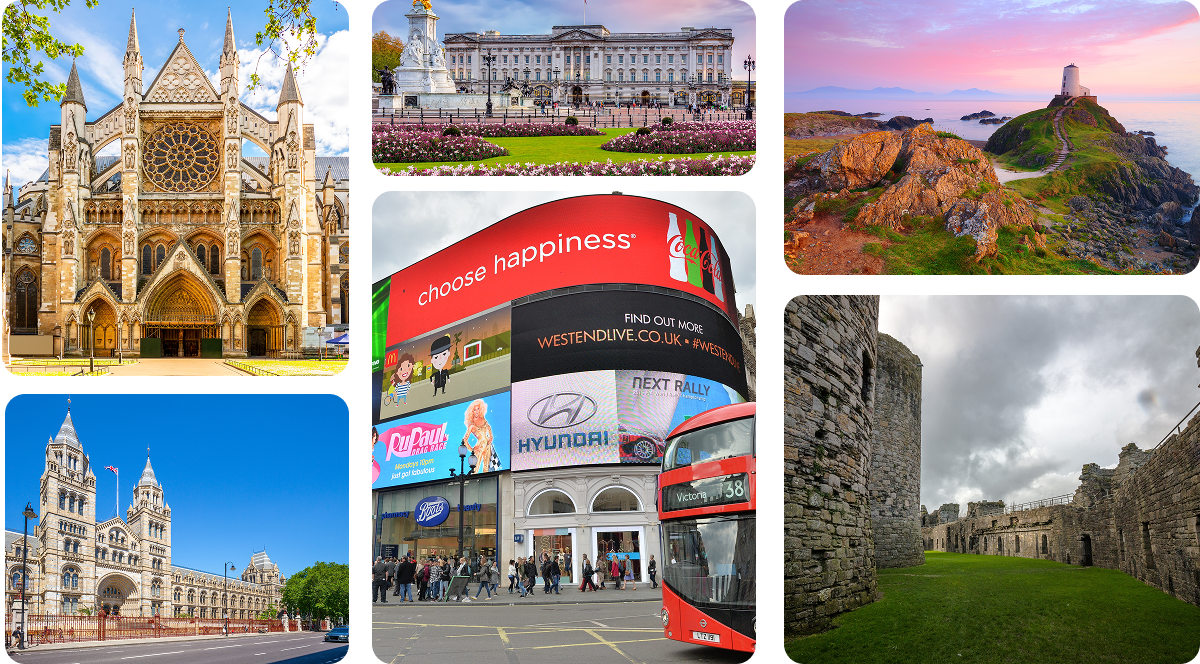

Some of the points of interest outside of Greater London include: the White Cliffs of Dover, Bournemouth Beach, Stonehenge, Oxford, Cambridge, Windsor Castle, Brighton Beach, High Force Waterfall, Woolacombe Beach, Canterbury Cathedral, Kynance Cove, St. Ives, and Lake District National Park, in England; Edinburgh Castle, Loch Ness, Stirling Castle, Loch Lomond and The Trossachs National Park, Isle of Skye, and the Scottish Highlands, in Scotland; Caernarfon Castle, Snowdonia National Park, Conwy Castle, Rhossili Bay, Pembroke Castle, Portmeirion, and the Tenby Beaches, in Wales; and Giant’s Causeway, Belfast Castle, Hillsborough Castle and Gardens, and Dark Hedges, in Northern Ireland.
When you relocate to the UK, you will have opportunities to visit these incredible points of interest along with many others!